The number of holes in a capsule filling machine is a direct indicator of its production scale. For pharmaceutical startups and medium-sized manufacturers, choosing between different hole counts is the first step toward automation.
While manual trays exist, the industry standard for precision and speed relies on Semi-Automatic and Fully Automatic capsule filling technology.
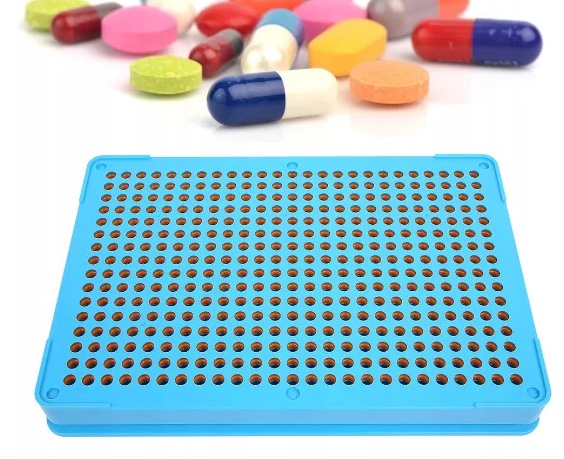
In semi-automatic systems, the hole count refers to the capacity of the filling ring. In fully automatic systems, it relates to the segments in the rotary table.
| Machine Type | Typical Hole Count | Approx. Output (pcs/hr) | Best For | Model |
| Manual Plate | 100 - 400 | < 2,500 | Lab R&D | - |
| Semi-Auto | 300 - 400 | 10,000 - 25,000 | Mid-scale production | ProCap-2, JTJ-A |
| Fully Auto (NJP) | Continuous | 12,000 - 450,000+ | Industrial Pharma | LTFK Series |
For most professional manufacturers, the 300-hole or 400-hole semi-automatic machine is the real starting point.
Unlike manual plates, these machines use vacuum systems for capsule orientation. This significantly reduces human error and operator fatigue.
A 400-hole semi-automatic machine can process up to 25,000 capsules per hour. It provides a massive leap in efficiency compared to manual methods while keeping the investment cost manageable.
Many beginners think a 400-hole manual tray is enough. However, the limitation of manual filling isn't the number of holes—it’s the Consistency.
LTPM's semi-automatic capsule fillers use pneumatic and electrical controls to ensure every capsule is locked with the same pressure.
This level of precision prevents "dented capsules" or "leaking powder," which are common issues in manual 400-hole setups.
When your production volume exceeds 30,000 capsules per day, hole count on a tray becomes irrelevant.
At this stage, you need the Fully Automatic NJP series. Instead of filling a batch of 400 at once, these machines fill capsules continuously in rotary segments.
LTPM's automatic filling machines use tamping pin technology. This ensures the powder weight variation is kept within 3%, meeting strict pharmaceutical pharmacopeia standards.
One operator can manage multiple automatic machines. This is impossible with manual or semi-automatic 400-hole trays, which require constant hands-on labor.
If you are processing sticky or high-density powders, a semi-automatic machine with an integrated powder feeder is essential to maintain speed.
Professional production requires more than just output. Our semi-auto and automatic machines are built with SS316L stainless steel and feature enclosed filling areas to prevent cross-contamination.
For pharmaceutical clients, we provide full IQ/OQ/PQ documentation. This is a service rarely available for simple manual filling plates.
Choosing between 100 and 400 holes is more than just a numbers game. It is about understanding your current workflow and where you want your production to be in the next 12 months.
While manual 400-hole machines offer a temporary boost, they often reach a "labor ceiling" that can hinder your growth and compromise batch consistency.
For professional manufacturers, transitioning to Semi-Automatic or Fully Automatic NJP systems is the only way to ensure precision, cGMP compliance, and long-term profitability.
By prioritizing automation over hole count, you protect your formulation's integrity and significantly reduce your cost per capsule.
Are you ready to move beyond manual filling and scale your operations with precision?
LTPM CHINA specializes in high-performance Semi-Auto and NJP Series Automatic Capsule Filling Machines tailored to your specific powder characteristics. Contact LTPM Now by [email protected] for a Technical Consultation.
1. Is a 400-hole manual machine better than a semi-automatic one?
No. While the hole count seems high, the manual labor involved makes it slow and inconsistent. A semi-automatic machine is much faster and ensures higher product quality.
2. What is the main benefit of upgrading from 400 holes to an NJP machine?
The main benefits are labor savings, dust-free operation, and much higher dosing precision. Automatic machines are also easier to validate for FDA audits.
3. Can LTPM customize the filling rings for specific capsule sizes?
Yes. We provide precision-machined changeover parts for all sizes, from #000 to #5, ensuring a perfect fit for our semi-auto and automatic lines.
 399 Dongxin Road, Ruian Economic Development Zone, Wenzhou City, Zhejiang Province, China


We use cookies to enhance your browsing experience and protect your privacy. Please read our privacy policy for more information.


