Choosing between a servo motor and a stepper motor is a critical decision in pharmaceutical machinery design. The motor is the heart of your automation system, controlling everything from dosing accuracy to production speed.
For high-speed NJP capsule fillers and rotary tablet presses, servo motors are the industry standard due to their closed-loop precision. Stepper motors remain a cost-effective choice for simple, low-speed auxiliary functions.
| Feature | Servo Motor | Stepper Motor |
| Control Logic | Closed-loop: Constant feedback via encoder. | Open-loop: No feedback; relies on pulse count. |
| High-Speed Torque | Excellent: Maintains torque at high RPMs. | Poor: Torque drops significantly as speed rises. |
| Accuracy | Micron-level: Self-corrects any position error. | Step-level: Risk of "lost steps" under load. |
| Operating Speed | High: Typically 3,000 - 5,000+ RPM. | Low: Best performace below 1,000 RPM. |
| Energy Efficiency | High: Current draw matches the actual load. | Low: Draws full current even when idle. |
| Heat Generation | Low: Runs cool; protects heat-sensitive API. | High: Constant current leads to high heat. |
| Noise & Vibration | Smooth & Quiet: Ideal for cleanroom use. | High: Audible noise and vibration at certain speeds. |
| Setup & Tuning | Complex: Requires PID parameter tuning. | Simple: "Plug and play" with basic drivers. |
| Initial Cost | Higher: Due to encoder and complex drive. | Lower: Economical for simple applications. |
| Best Used For | High-speed NJP fillers & Tablet presses. | Labeling machines & low-speed conveyors. |
The table above provides a technical snapshot, but for a pharmaceutical facility, the real impact is seen in batch consistency and compliance. Below, we break down these core differences in detail and explain how they influence the performance of LTPM’s high-precision machinery.
A motor’s primary job in a pharmaceutical environment is to convert electrical energy into precise mechanical movement. The way these two motors handle that conversion defines their long-term performance and reliability.
A stepper motor moves in discrete increments or "steps." It operates on an open-loop system, meaning it sends a command and assumes the motor has reached the target position without verifying it.
A servo motor utilizes an encoder to provide constant feedback to the controller. This closed-loop system allows the machine to "know" its exact position at every millisecond, correcting errors instantly.
Torque is the rotational force required to move heavy mechanical components, such as the rotary table of a high-speed tablet press or a capsule filling disk.
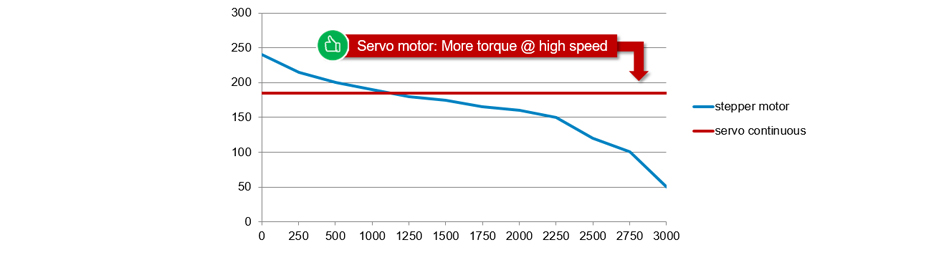
At high speeds the stepper motor torque approaches zero while the servo motor provides consistent torque throughout the entire speed range. image source: AMCI
Servo motors maintain nearly 100% of their rated torque even at high RPMs. This stability is essential for maintaining consistent pressure during the tablet compression stage, ensuring every tablet meets hardness standards.
In contrast, stepper motors suffer from "torque drop-off." As the speed increases, the available force decreases significantly. This limits the machine's throughput and can lead to mechanical stalls during heavy-duty cycles.
Pharmaceutical machines involve frequent start-stop cycles, especially during the capsule orientation phase. Servo motors handle these rapid transitions with minimal vibration and high dynamic response.
In the pharmaceutical world, a fraction of a millimeter can be the difference between a perfect dosage and a rejected batch that fails USP standards.
The biggest risk with a stepper motor is "losing steps." If mechanical resistance increases slightly, the stepper may miss a move. The controller will not know, leading to inconsistent filling weights.
Servo motors eliminate this risk via their encoder. If a servo misses a position, the system sends a correction signal. This self-correcting feature is vital for meeting strict weight variation standards in high-volume production.
Servo motors offer much higher resolution. This results in smoother movement for delicate processes like film coating. Constant pan rotation ensures a uniform application of the coating liquid without "orange peel" defects.
Speed is directly tied to your ROI (Return on Investment). If your motor cannot handle high speeds, your production capacity is permanently capped.
Servo motors comfortably operate at speeds of 3,000 to 5,000 RPM. This high-speed capability allows LTPM machines, like our NJP-series, to process hundreds of thousands of units per hour without losing accuracy.
Stepper motors are generally limited to under 1,000 RPM. Beyond this point, the motor loses synchronization. This makes steppers unsuitable for modern, high-speed pharmaceutical manufacturing lines.
Servo motors have superior acceleration profiles. They reach top speed faster, which reduces the "dead time" in each production cycle, effectively increasing your total daily output.
Cost is always a factor, but it must be viewed through the lens of TCO (Total Cost of Ownership) rather than just the purchase price.
Stepper motors are undeniably cheaper. Their drive electronics are simpler, making them attractive for low-budget, entry-level equipment or manual lab tools where speed is not a priority.
Servo systems require specialized drives and high-resolution encoders, which increases the initial purchase price of the pharmaceutical machine.
Servo motors are more energy-efficient. They only draw the current required for the specific workload. Stepper motors draw full current constantly, leading to higher electricity bills and excessive heat generation.
Pharmaceutical powders are often sensitive to temperature fluctuations. A motor that runs hot can transfer heat to the product contact parts, compromising the API.
Because stepper motors operate at full current regardless of the load, they generate significant heat. In a closed pharmaceutical environment, this can affect the stability of heat-sensitive active pharmaceutical ingredients (API).
Servo motors stay cool during operation. Their efficient power management is a key feature in LTPM’s aseptic and heat-sensitive production lines, ensuring the physical and chemical integrity of your drugs.
In a rotary tablet press, the filling cam and the dosing rail require extreme precision to ensure uniform tablet weight.
LTPM utilizes servo-driven dosing systems to control the depth of fill in the die cavity. This allows for real-time adjustments based on signals from the tablet weight sensor.
If the sensor detects a light tablet, the servo motor micro-adjusts the dosing rail instantly. This level of automation ensures zero-waste production, a feat impossible with a standard stepper motor setup.
The NJP series relies on the "tamping pin" method, where powder is compressed into a uniform slug before being inserted into the capsule.
The tamping pins and the rotary disk must be perfectly synchronized. Servo motors allow for "electronic gearing," where all moving parts are locked together digitally rather than mechanically.
This reduces mechanical wear. It replaces old-fashioned chains and gears with precise motor pulses, resulting in a quieter, more durable machine with much longer maintenance intervals.
Downtime in a pharmaceutical facility can cost thousands of dollars per hour. Choosing a motor with predictive maintenance capabilities is essential.
Servo motors are built for continuous, 24/7 industrial use. They have built-in diagnostic features that can alert operators to mechanical issues—such as increased friction—before a failure occurs.
As we move toward Industry 4.0, the intelligence of the servo motor becomes critical. Servo drives can export data regarding torque and speed, which is essential for digital batch reporting and FDA compliance.
The choice between servo and stepper motors depends on your production goals and compliance requirements.
If you are running a small R&D lab with low output requirements, a stepper motor system may suffice. The lower cost allows for a faster initial setup.
However, for professional pharmaceutical manufacturing, the Servo Motor is the clear winner. Its combination of speed, torque stability, and closed-loop precision ensures that your production line remains profitable and compliant.
LTPM CHINA provides high-end NJP Capsule Fillers and Tablet Presses equipped with world-class servo motor technology. Get a Quote for a Servo-Driven Machine Today
1. Can I upgrade my old stepper-driven machine to a servo system?
Yes, but it usually requires a complete overhaul of the control system and PLC. It is often more cost-effective to invest in a modern, servo-driven LTPM machine.
2. Do servo motors require specialized training for operators?
Modern HMI interfaces simplify servo operation. The operator interacts with a touchscreen, while the complex feedback loops happen in the background.
3. How does motor choice affect cGMP compliance?
Servo motors support better data logging and precision, making it easier to pass IQ/OQ/PQ validation and maintain the strict tolerances required by cGMP.
 399 Dongxin Road, Ruian Economic Development Zone, Wenzhou City, Zhejiang Province, China


We use cookies to enhance your browsing experience and protect your privacy. Please read our privacy policy for more information.


